Showing posts with label Year B First Sunday in Lent. Show all posts

Saturday, February 24, 2018

Mark 1:9-15


Mark 1:9-15 (NRSV)

9 In those days Jesus came from Nazareth of Galilee and was baptized by John in the Jordan. 10 And just as he was coming up out of the water, he saw the heavens torn apart and the Spirit descending like a dove on him. 11 And a voice came from heaven, “You are my Son, the Beloved; with you I am well pleased.”

12 And the Spirit immediately drove him out into the wilderness. 13 He was in the wilderness forty days, tempted by Satan; and he was with the wild beasts; and the angels waited on him.

14 Now after John was arrested, Jesus came to Galilee, proclaiming the good news of God, 15 and saying, “The time is fulfilled, and the kingdom of God has come near; repent, and believe in the good news.”

          Mark 1:9-15 contains the stories of the baptism and temptation of Jesus, as well as a summary of the preaching of Jesus in Galilee.

            The theme of Mark 1:9-11 is the story of baptism of Jesus by John the Baptist. This baptism has the primary implication for us today in that when we receive baptism, we are publicly uniting ourselves with and standing with Jesus. In that sense, it becomes the basis for the early church to invite new believers to submit to baptism as well. Baptism is a sign that the favor or grace of God rests upon us. Baptism is a form of anointing us for ministry. Baptism is a sign that we have committed ourselves to the reign of God. As the baptism of Jesus by John the Baptist stands at the beginning of his public ministry and had implications throughout that ministry, so our baptism stands at the beginning of our vocation to become increasingly a Christian. God calls Christians into fellowship with Jesus. In that way, the beginning of the ministry of Jesus is not of merely historical interest. It became exemplary, normative, and binding in respect of the form of the beginning of their new life. The beginning of a life of fellowship with Him is at issue. It followed His act of submission to God, of solidarity with humanity, and of service to God.

            We learn that 9In the days of the preaching of John the Baptist Jesus came from Nazareth of Galilee (28 AD). We know from other sources that nationalist uprisings occurred when Jesus was two and twelve. However, a non-violent protest by peasants occurred in Caesarea occurred against Pilate. A few months later, Jesus will come to the Baptist for baptism. It will be the first crucial decision he makes publicly. We can understand the ministry of the Baptist as inviting people to leave “Egypt,” that is, Jerusalem and the corrupt ways of institutional life in Israel and come to the wilderness. The Baptist patterned his ministry after Moses, Elijah, and other prophets. Significantly, however, Jesus does not stay with John in the wilderness. He will return to Galilee. John the Baptist baptized Jesus in the Jordan. The question naturally arises as to why Jesus was among those who freely submitted to the baptism of John. This act of Jesus is one of the few incidents in the life of Jesus in which scholars agree that it happened. The question arises as to whether Mark thought Jesus needed the kind of repentance and forgiveness the baptism of John signifies. Some would suggest a plain reading of the text demands an affirmative answer. I think a plain reading suggests a negative answer, given the private revelation to Jesus that occurs after his baptism. Thus, Mark then offers us a theological interpretation of this event in the life of Jesus. For Mark, the relationship between John and Jesus is not important. Rather, the revelation from God, which he now shares, is what is important to him. What occurs after the actual baptism is the primary point of the baptism. Thus, 10 as Jesus came up out of the water, he saw first, the heavens torn apart, a violent verb signaling the beginning of the ministry of Jesus. Mark will use the save verb in 15:38 to describe the tearing of the curtain in the temple. Both events go completely unnoticed by others. Second, Jesus saw the long absent Spirit, which swept over the face of the waters in Genesis 1:2, descending through the torn open heavens like a dove. Such an image is not common in Judaism. An interesting recognition among scholars is that in the Roman imagination, the descent of a bird was a crucial omen for the life of a great leader. Usually, this bird was an eagle, the symbol of Roman legions and military might. Mark uses this trope but subverts it, placing the peaceful dove instead of the aggressive eagle. The reign of God, for which Jesus is the sole leader, comes as a peaceful and sacrificial dove instead of the Roman eagle. The dove descended on him (εἰς αὐτόν, even into him). However, the resting upon persons, as in Isaiah 11:1-3, is a feature of prophetic literature. The point is that the living presence of the Holy Spirit will empower the ministry of Jesus. John had promised that the one to come after him would be different, and we see here the first expression of that difference.  The baptism is the beginning of the eschatological age, which the theological significance of the Father tearing open the heavens and the Spirit descending like a dove on him. Further, 11a voice came from heaven, which we will not hear from again until the transfiguration of Jesus, saying, “You are my Son, (Psalm 2:7 as a royal psalm) the Beloved; with you I am well pleased (Isaiah 42:7 as a suffering servant).” Mark can begin his gospel seriously, having revealed to us the unique nature of Jesus of Nazareth. These verses reflect a private revelation to Jesus, or better, a private confirmation. They reveal the future of Jesus as king and servant, enthronement and suffering. We should view this combination of Messiah and suffering servant as a uniqueness that comes from Jesus of Nazareth. They convey an intimate, unfathomable moment of closeness between the beloved and the ultimate power of the universe. As readers, we will know things about Jesus that the disciples and the contemporaries of Jesus will not know. Mark keeps the secret hidden from the view of others, even if he does not keep secret from us. God chooses an unknown person from a small village in a marginal region. Jesus did not have the right pedigree. Yet, the choice of God occurs apart from recognized human authorities. We have here the impartation of the Spirit and the thought of adoption.[1] Some scholars will remind us that the Roman emperor designated his successor as his son. Often, this son was not the biological son but one of his adopted sons. Jesus is the elect Son of God.[2] As such, Jesus becomes a model of election as serving humanity for the mission God gave him.[3] The baptism proclaims divine sonship and relates it to the future of his public ministry.[4] Such statements have validity only from the standpoint of the Easter event.[5] Yet, what will all this mean? Mark will show the reader throughout the gospel. Mark has set the stage for the one who is more powerful than the Baptist, who will baptize with the Holy Spirit. The one whose identity we as readers of this gospel know will contest with human beings who stand opposed to the good news and the rule of God. 

            The theme of Mark 1:12-13 is the story of the temptation of Jesus. In terms of sources, it would be almost impossible to understand the account of the temptation of Jesus in Mark apart from Matthew and Luke. However, I will focus upon this story in the context of Mark. 

            Part of the context involves Jesus alone in prayer. Jesus frequently withdrew from the crowds and the disciples. He usually sought a deserted place to pray. After the feeding of the 5,000, Jesus dismissed the crowds and "went up the mountain by himself to pray" (Matthew 14:23; cf. John 6:15). After Jesus spent a day preaching and healing, the next morning, "while it was still very dark, he got up and went out to a deserted place, and there he prayed" (1:35). He prepared himself for choosing the twelve as "he went out to the mountain to pray; and he spent the night in prayer to God" (Luke 6:12). Crushed by the crowds who wanting healing, Jesus frequently withdrew to deserted places to pray (Luke 5:16). What Jesus gives us about prayer is primarily by his own example, which, most of the time, is to withdraw to a deserted place to do it. This practice teaches us a few things. For one thing, it suggests that we need to be intentional about finding a time and place to pray and listen. His practice can also help us think differently about deserted places in our lives. Such a place might be physical. It could also mean the places in our lives where we forget to invite God. If we are open, we can turn any moment, even a long drive, into a moment of prayer. A deserted place can also refer to places where we lack what others of have. A deserted place may be the place we feel alone because of temptation, rage, discouragement, doubt, or some other inward experience. Such moments are times to pray. 

            Jacques Maritain wrote to a 17-year-old girl. She found herself in a deserted place where she felt she had lost God. She was angry about it. She wrote to Maritain. He told her that things would not always look to her as they did in this moment. He urged her to use every ounce of her intelligence. He suggested some things to read. He then added that he would not advise her to wait. Rather, she should take advantage of her brokenness and feeling like life had beaten her into the ground. This moment can set her on a real search for truth. She can put her childhood behind her. He invites her to pray, even if she stammers and blasphemes. He even encourages her to tell God that if God exists, God needs to make that existence known to her.

            We learn that 12 the Spirit immediately drove Jesus out into the wilderness, as if by strong, if not violent, compulsion. The desert is the habitation of demons. 13 He was in the wilderness forty days (Deuteronomy 8:2, the days Noah waited after the flood), tempted by Satan, the title Mark prefers, as does Paul. Yet, what was this, that Jesus encountered temptation?

For us he was baptized, and bore 

His holy fast, and hungered sore; 

For us temptation sharp he knew, 

For us the tempter overthrew.[6]


Temptation refers to allurement or enticement to do evil. Temptation is like a trap into which the unwary can fall (I Timothy 6:9). Any test of moral virtue is a temptation to the one tested. Satan tempts because he wants to destroy. Human beings succumb to temptation because they have strong desires toward sin and evil.[7] Temptation distracts, beguiles, and bullies us off the path. It makes real life different from the world of our dreams. Our dreams imagine a world that we can mold to our aspirations and ambitions. We meet a world of trial that we do not have the character or virtue to surmount. We encounter seductions we do have the virtue to resist.[8] It may well be that

The last temptation is the greatest treason; 

To do the right deed for the wrong reason.[9]


Further, Jesus was with the wild beasts. Here is the most enigmatic statement in the account. My instinct is to think of the dangers that Jesus encountered in the wilderness. To put it on a personal level, we could ask ourselves to name the wild beasts in our lives. We want to know its name and face. If we do this as a community, then I need to consider that the best you face may be a beast I face. Yet, it could be a peaceful reference to the messianic ideal of a restoration of the heavenly peace as in Isaiah 11:6-9, where lion and lamb are at peace and children can play with poisonous snakes. Patristic era commentators took this approach. For them, the presence of the “wild beasts” drew a parallel with Adam while in the garden of Eden. Once more Satan is tempting the “human one” (to anticipate Jesus’ self-designation as uios tou anqropou beginning at 2:10 and throughout this gospel) amid the beasts, but this time the “human one” prevails and to the point where angels ministered to him, rather than the angels driving him out, as we find in Genesis 3:22-24. On this reading of the “wild beasts,” the “wilderness” is not a satanic and Godforsaken place. Rather, God is present with Jesus throughout this trial in the same way God was present with Adam in Eden and Israel in Sinai. Yet whereas both humanity generally (Adam) and the chosen people of God (Israel) have failed such temptations in the past, this time the “human one” succeeds in plundering Satan’s house (Mark 3:27). Further, the angels waited on Jesus, representing divine protection. This story could suggest that there are terrors, and there are gracious powers to help us face them. All of this could mean than that this passage signals that the eschatological warfare is beginning, centering upon Jesus.  This passage is intense and shows the trials of the experience which Jesus endured.  Many at this time believed wild beasts to be demon possessed.  Yet, God’s protection was there during the trial.  Thus, Jesus fully identifies with the people of God, who have their own wilderness to go through in life.  It could be a preview of the struggle to come.  The scene could portray both the danger of the wilderness and the protection of Jesus as Son of God.  It is also important to ask how the wilderness sojourn functions in the introduction of Mark’s gospel.  The wilderness sojourn prevents readers from assuming that the ministry of Jesus will be one of exaltation and glory.[10]

I think it helpful to consider these few verses considering the context. From the very start of the gospel of Mark, the ministry of Jesus is a contest. This contest seems at first to be pitting evil spirits against the Holy Spirit, with the numerous references to "Spirit" in this first chapter leaving no question on whose side Jesus is. Pheme Perkins points out that the first voice in the desert, that of John the Baptist, announces that the one who is to come will baptize with the Holy Spirit (v. 8). The Spirit descends on Jesus when he receives baptism (v. 10) and drives Jesus into the wilderness to receive temptation from Satan (vv. 12-13). The first miracle of Jesus involves driving an unclean spirit out of a man (vv. 23-27). Nevertheless, is this contest really between evil spirits and the Holy Spirit? Perhaps not. Satan is no match for Jesus in the gospel of Mark, and the evangelist never describes the two as locked in serious combat. "Jesus' opponents in this gospel will turn out to be human beings. The struggle lies in the distance between the human and the divine." Jesus ends up fighting the scribes from Jerusalem, who accuse him of using demonic power (3:22-27). Jesus struggles with Peter, and even calls him "Satan," because Peter rejects the passion of Jesus and refuses to accept the plan of God (8:33). The real contest, you see, is between humans and Jesus, between old humanity and the new Son of God. Mark opens his gospel by "preparing the way" for the Christ, using all available symbols and appropriate images from the Old Testament.

The theme of Mark 1:14-15 is that of providing a summary of the preaching of Jesus. The source is Mark.  The good news is about God.  Jesus calls for a response to the coming rule of God.  We will note the temporal and spatial dimensions of the kingdom.

            In context, Mark 1:12-13 has rehearsed the exodus experience of Israel in the desert in which the experience tests their faith in Yahweh, as in Deuteronomy 8:2.  The difference is that Jesus relived the wilderness experience without yielding to the testing, while Israel failed its test.  Mark has dismissed Satan. He has John arrested and in prison before the preaching of Jesus begins. He has set the stage for Jesus to begin preaching the gospel of God.  

            This text begins with a crucial "hinge" statement that moves the reader from Mark's prologue that includes and introduces the central people and events that together prepare Jesus for his public ministry. Mark 1:14-15 forms the threshold of the entrance of Jesus into the Galilean ministry, which is by far the most extensive portion of Mark's gospel. 

In Mark, the rule of God is a reality of the near or immediate future.  Indeed, the appearance Jesus and the appearance of the rule of God are the same.  Mark rarely defines the content of the preaching of Jesus. Where Mark specifies the message of Jesus precisely, it is the announcement of the rule of God.  The tangible power of the rule of God is also apparent from the way others react to Jesus and his message. 

Mark 1:14 firmly close the door on any active role for John the Baptist: 14 Now after John was arrested John the Baptist's active role by revealing that the authorities arrested (παραδοθῆναι later translated as betrayed, delivered up, and handed over in 9:31, 10:33, 14:21, 41). The time of John is past. The time has come to focus one he prophesied would come. The end of the ministry of John reminds the reader of the fate awaiting Jesus. Jesus begins his public proclamation only after the imprisonment of John the Baptist.[11] Thus, Jesus came to Galilee, Mark letting us know that Jesus did not stay with John in the wilderness very long. The ministry of Jesus will be among the cities and towns of Galilee rather than in the wilderness. He will make Bethsaida, Chorazin, and Capernaum the center of his public activity. Mark describes the message of Jesus as proclaiming (κηρύσσων) the gospel or good news (εὐαγγέλιον) of God, which may explain why the early church used the term “gospel” for the comprehensive presentations of the Jesus tradition.[12]

The content of Jesus' proclamation is fourfold in Mark 1: 15. For some context, this summary of the content of the preaching of Jesus is like Isaiah 52:7. The prophet writes of the beauty of those who bring good tidings, who publishes peace, who brings good tidings of good, and who says to Zion, “Your God reigns.” 

The first part of the summary is that in the arrival of Jesus, we find Jesus proclaiming 15 and saying, “The time (καιρὸς) is fulfilled (Πεπλήρωται). God is the one fulfilling time in this way. Mark is not referring to chronos (extended time), but kairos (the right time for something to happen). According to Mark, the right time is after the arrest of John and the right place is the moment of the arrival of Jesus in Galilee. At this time, God steps into human history in a unique and decisive way. The time of John the prophet is over; the time of Jesus and fulfillment has begun. John predicted the coming of the One who would baptize with the Spirit. If the arrival of Jesus fulfills the time, it indicates that the ministry of Jesus will bring about the age of salvation anticipated by the prophecy of John. “Fulfilled” refers to a completion of the past, and thus a keen sense of continuity.  Scripture, Law, and the purpose of the old covenant find their fulfillment in Christ. “The time you have been waiting for, the time announced by the prophets, is finally here! The glorious new day of the rule of God has just dawned!" We can see here a partial basis for saying that Jesus is Lord of time. In Matthew 13:16-17, this generation receives so much blessing from God because it has seen and heard Jesus. In Galatians 4:4, Paul refers to the fullness of time as being the moment when the Father sent the Son into the world. Ephesians 1:10 says that in the fullness of time, God is summing up all things in Christ. The promises and prophecies of the Old Testament find their fulfillment in the arrival of Jesus. If the time finds its fulfillment, the fulfillment comes in a moment, an event, in the arrival of Jesus. This real event occurs as a particular event and a particular time, a center around which all other times will revolve. The time before has moved toward Christ. The time after Jesus moves away from this event. Humanity has time because Jesus had his time. We have the fullness of our time because we orient ourselves to and live our lives from the perspective of the time Jesus has. The purpose of our time after this decisive event is to allow space before the rule of God to repent and believe. Those who do believe have as their primary purpose to make known this event. They too must wait expectantly, even as the universe waits, for this last event.[13]  

The second piece of the proclamation of Jesus: and the kingdom or rule of God has come near (ἤγγικεν). Jesus spoke of the rule of God as close or already present but hidden, and thus in a way that frustrates ordinary expectations. The central content of the message is the dawning of the reign of God, indeed in the sense that God has already entered upon that reign. Note the similarity of this message to the central theme of Jesus as identified by this verse, although in relation to its future Jesus saw the divine reign as still in the process of dawning.[14] It implies the irruption of the reign of God into history is imminent. Even if we translate that the rule of God “has come,” it would refer to God revealing it in moments like the resurrection. Until the full revelation to all persons comes, we can only pray for the coming rule of God. Yet, we can see the subtle notion of the presence of God when Jesus says that he casts out devils by the Spirit of God, then the rule of God has come upon them (Matthew 12:28). The salvation promised for the end is a present reality in the healings and exorcisms of Jesus. The rule of God is in their midst (Luke 17:21). Jesus even sees Satan falling (Matthew 11:12).[15] Scholars debate what this summary says. Does it mean the reign of God is about to arrive or that it is already here? These passages suggest the answer could be both. For Mark, the rule of God has both present and future dimensions. We have already seen this in John the Baptist's message. John announces Jesus' imminent arrival, and Jesus appears. As Jesus begins his public ministry, the rule of God lay in the immediate future. As the story of Mark's gospel unfolds, those who encounter the power of God through the words and works of Jesus experience the rule of God as present yet hidden; the fullness of the rule of God remains the object of prayer and expectant waiting but is mysteriously present in the ministry of Jesus. 

The third piece of Jesus' proclamation is the same message John preached - the call for people to repent (μετανοεῖτε). The prophetic theme of conversion is not prominent in the message of Jesus, even though this passage brings it to the fore as a theme of the preaching of Jesus. Yet, one could say that the summons to subordinate all concerns to seeking the reign of God in human life naturally implies very strongly a conversion to God. Conversion, for Jesus is not a precondition of participation in the reign of God. At the center of his message is the imminence and presence of the rule of God for believers.[16] To repent does not mean merely to turn away from a specific sin but turning toward God in faith and obedience. Repentance meant a complete about-face, a turning around of the mind, a changing of life and lifestyle, the taking of a radical new direction. The primary theme of the preaching of Jesus is that the rule of God has come near. This theme naturally leads into the call to hearers to turn around, to shift the direction of their lives, to look, listen and give their full attention to the arrival of the rule of God. Such repentance means complete re-orientation, both inward and outward, of the whole person to the God who truly has turned to humanity in time.[17] Such repentance implies genuine knowledge of oneself that includes our participation in sin.[18]

The final piece of the summary of the proclamation of Jesus is the call to believe (πιστεύετε) in the good news (εὐαγγελίῳ). In Mark, belief is trusting in the coming rule of God.  It involves a letting go of the things to which we cling to for security and identity. Believe the good news that the rule of God is arriving. Where Jesus is, there the rule of God is actively at work. However, this truth is not self-evident. For one to see it, one must believe it. It involves a letting go of the things to which we cling to for security and identity. The call to believe is not an intellectual exercise, but a call to trust. To believe in the good news means to wager one's future on the reality of God's involvement in the world through the person and ministry of Jesus Christ, despite the skepticism of the modern worldview. In the work of Jesus, the call for conversion rests on the message of the inbreaking of the future of God in the coming of Jesus and for those who accept the summons in faith. The proclaiming of the presence of the rule of God and its salvation in those who in faith rely on its all-determinative future is now a motive for conversion to God on the part of the hearers.[19] Faith means the unquestioning trust in this God that is the positive side of this re-orientation; the new life that is the only possible life after this event in the time that follows it.[20]

While these two "hinge" verses may appear at first to form a straightforward gate into the next phase of Jesus' ministry, in many ways they reflect the paradox that Jesus' own human/divine identity embodied. The fact that the "time" is both "fulfilled," and yet not proclaimed as "here and now" but as "come near," highlights the tension that accompanies the arrival of the rule of God. It is both "now" and "not yet." The content and the consequences of the message of Jesus also seem to be at odds. On the one hand, Mark describes the proclamation of Jesus as "good news," yet, at the same time, this "good news" is such that it demands all hearing it to "repent." Indeed, the call to repentance precedes the call to faith, to "believe." The content of this "good news," therefore, would appear to be not all that "good" to most of us. John the Baptist's call to repentance was in anticipation of the arrival of God's messenger. The call of Jesus to repentance is more urgent. His declaration that the "time is fulfilled" makes repentance an immediate requirement, not some distant goal. The "Good News" of the reign of God thus demands that the hearers accept the "bad news" about their current condition and "repent" accordingly.


[1] Pannenberg, Systematic Theology Volume 1, 266.

[2] Pannenberg, Systematic Theology Volume 1, 306.

[3] Pannenberg, Systematic Theology Volume 3, 457.

[4] Pannenberg, Systematic Theology Volume 1, 309.

[5] Pannenberg, Systematic Theology, Volume 2, 247, 365.

[6] c. 15th century, Benjamin Webb (1819-1985), tr. Hymns and Psalms, London: Methodist Publishing House, 1983

[7] (J. C. O'Neill, Westminster Dictionary of Christian Theology [Philadelphia: The Westminster Press, 1983].)

[8] Austin Farrer, A Celebration of Faith, London: Hodder & Stoughton, 1970 

[9]  - T. S. Eliot

[10] Mann, Mark in Anchor Bible series.

[11] Pannenberg, Systematic Theology Volume 326.

[12] Pannenberg, Systematic Theology Volume 2, 455.

[13] Barth (Church Dogmatics III.2 [47], p. 459-461)

[14] Pannenberg, Systematic Theology Volume 2, 456.

[15] Barth (Church Dogmatics III.2 [47], p. 459-461)

[16] Pannenberg, Systematic Theology Volume 2, 311.

[17] Barth (Church Dogmatics, III.2, [47], 461)

[18] John Wesley gives a long description of this self-knowledge in sermons 14 and 15.

[19] Pannenberg, Systematic Theology Volume 3, 245.

[20] Barth (Church Dogmatics, III.2 [47], 461)

Friday, February 23, 2018

I Peter 3:18-22


I
Peter 3:18-22 (NRSV)

18 For Christ also suffered for sins once for all, the righteous for the unrighteous, in order to bring you to God. He was put to death in the flesh, but made alive in the spirit, 19 in which also he went and made a proclamation to the spirits in prison, 20 who in former times did not obey, when God waited patiently in the days of Noah, during the building of the ark, in which a few, that is, eight persons, were saved through water. 21 And baptism, which this prefigured, now saves you—not as a removal of dirt from the body, but as an appeal to God for a good conscience, through the resurrection of Jesus Christ, 22 who has gone into heaven and is at the right hand of God, with angels, authorities, and powers made subject to him.

              I Peter 3:18-22, in a segment that began in verse 17, are the theological support for the exhortation in verses 13-16.  

Do not court martyrdom.  They should follow the example of Christ. 18 For Christ also suffered for sins once for all. This assertion of the universality of the suffering of Christ reminds the reader that those who persecute them today might well become the believers of tomorrow.  Just as Paul stated, "while we still were sinners Christ died for us" (Romans 5:8), Peter reminds his hearers that while they are to be righteous, they are not to forget that the unrighteous are also those for whom Christ died. This passage suggests that the nature and efficacy of the suffering and death of Jesus are central issues.  There were differing opinions within the early church about the significance of Christ's crucifixion. The church of the first century raised many questions. "Did Jesus really suffer?" "Why did Jesus have to die?" "If Jesus died for sins, is it true that every time we sin we crucify Jesus again?" It even asked, "What did Jesus do before his resurrection?" Many in the early church held to a Docetic view of the divinity of Christ that denied the humanity of Jesus. A dualistic view of the world grounded early Docetism They considered it impossible that a divine being would ever assume human flesh. The early church regarded this kind of doctrine as heretical. Yes, Jesus really did suffer, and human beings put him to death in the flesh. Furthermore, he suffered for sins once and for all: the righteous for the unrighteous, for Jesus was a righteous man who suffered for the deeds of the unrighteous, in order to bring you to God.  Peter gets very personal: Jesus died to bring "you" to God. Peter will not allow the argument to get too academic or theoretical. He was put to death in the flesh, but made alive in the spirit. What Christians believe about the crucifixion of Jesus is very down-to-earth and very fleshly. It is important for Peter to stress the suffering of Jesus, for the Christians to whom Peter writes are suffering for their faith and need to receive support and encouragement. In suffering, the believer imitates Christ and becomes an example to the unbeliever.  Yet, Peter does not make the opposite mistake - stressing the fleshly at the expense of the spirit. Again, we can see a pastoral and personal note to these words. If the believer is going to suffer like Jesus, then Peter wants them to know that they, too, will share the resurrection spirit with Jesus; in short, there is a reward for the present situation.  The theology of Peter reflects an earlier strain of tradition. Peter is telling us that death is not a barrier God cannot get past. If death were the last word, then death and not God would be the Supreme Being. However, Peter knows that is not the case because God raised Jesus from the dead. Thus, Paul affirms, "For to this end Christ died and lived again, so that he might be Lord of both the dead and the living" (Romans 14:9). Peter asserts the supremacy of God over death itself.

I Peter 3:19-20 presents another way in which Jesus is the example for believers. The emphasis is that Christ preached, and that he preached to these evil spirits.  That is a model for Christians, who also need to speak boldly before the heathen rulers. Along with I Peter 4:6, this brief passage becomes the basis for the statement in the Apostles' Creed that Christ "descended into hell." Reflecting upon what he just said about death in the flesh and life in the spirit for Jesus, Peter then affirms 19 in which (form) also he went and made a proclamation to the spirits in prison. Jesus is again an example, this time in preaching to the worst of sinners.  The death and resurrection of Jesus have broken the power of paganism. This statement alludes to the descent of Christ to Hades between his death and resurrection. His flesh was decaying, so his spirit went there. Some think Matthew 12:40 refers to this event, where the Son of man is in the heart of the earth for three days and three nights.  In addition, God frees Jesus from the pangs of Hades, for it was impossible for the power of Hades to hold him (Acts 2:24). God did not abandon Jesus to Hades, where his body did not experience corruption, as one might normally expect (Acts 2:31).  Paul refers to going down to the depths and bringing Christ back from the dead (Romans 10:7).  Christ had gone down to the deepest levels of the earth (Ephesians 4:9).  "Holy ones" came out of their graves, rose from the dead, and appeared to several people (Matthew 27:52-53). The interpretation favored by Calvin, that Jesus died the hellish death of the truly wicked, can be helpful to us when we go through hellish experiences where we feel utterly alone. We can take comfort in knowing that we can go nowhere Christ has not already been. He is present for us even in the darkest places, and though we may feel all on our own, we are not ever godforsaken when we trust him. It suggests that the worst that can befall human beings is within the redeeming embrace of the cross. The reference to spirits in prison could refer to the chained demons mentioned m the Book of Enoch, over whom Christ has authority.[1] Peter raises the difficult matter concerning those who had died before Christ. He seems to reflect an earlier strand of tradition grounded in the imagery of the prophet Ezekiel's vision of the dry bones coming to life (Ezekiel 37:12-13). Peter goes on to identify those in prison as those 20 who in former times did not obey, when God waited patiently in the days of Noah, suggesting the indifference of heathens to the gospel. The spirits in prison could also refer to those who died at the flood.[2] The legends surrounding the corruption of humanity prior to Noah were an important part of Jewish thinking. It is enough to note that by the first century after Christ, this legend had gone through considerable elaboration. Peter is making a statement for the graciousness of God who, through Christ, saves not only the righteous members of Noah's family, but saves even the unrighteous. Peter is stressing that the gospel itself is not limited to the time of Jesus and forward, but also is efficacious retroactively. We need to remember that the faithful dead of the Old Testament find inclusion in the people of God as understood in the New Testament. Abel, Enoch, Noah, Abraham, Sarah, Isaac, Jacob, Joseph, Moses, Rahab and other persons of faith and even that "All of these died in faith without having received the promises, but from a distance they saw and greeted them" (Hebrews 11:13). 

C.S. Lewis (The Great Divorce) refers to the massive difference between this world and the next. At one point, Lewis describes a conversation between a heavenly guide and a man who is considering entering heaven. They are talking about those who choose hell, and the guide explains that those who do so have shut themselves off from the powers of goodness. So, the man asks, "Then no one can ever reach them?" The guide replies, "Only the Greatest of all can make Himself small enough to enter Hell. For the higher a thing is, the lower it can descend -- a man can sympathize with a horse, but a horse cannot sympathize with a rat. Only One has descended into Hell." The man asks if he will ever do so again. The guide says, "It was not once long ago that He did it. Time does not work that way once ye have left the earth. All moments that have been or shall be, were, or are, present in the moment of His descending. There is no spirit in prison to whom He did not preach." The man asks, "And some hear him?" "Aye," replies the guide.

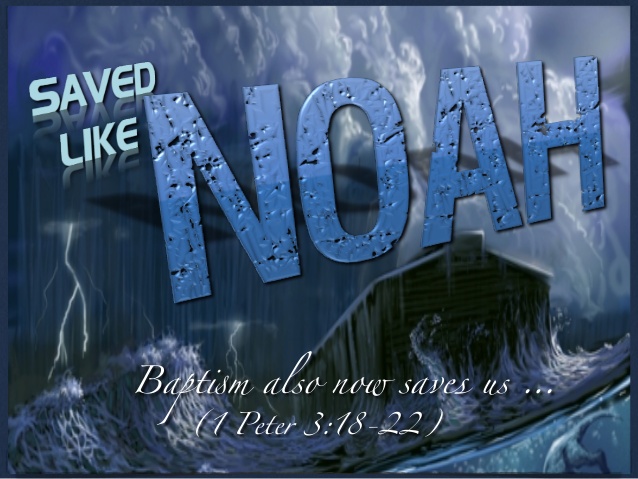
Further, the spirits in prison lived during the building of the ark, the ark referring to the church, which anticipates the coming disaster. Further still, in which a few, that is, eight persons, God saved through water, symbolizing baptism. The floods saved Noah from evil people; God saves Christians from evil through baptism. The flood signified death of the old world and beginning of the new, so baptism is death of the old person and birth of the new.

St. Gregory Nyssa also wrote an Easter homily called “‘The three-day period of the Resurrection of Christ.” In it, he said Christ purposely concealed his real identity from the devil when he died. So, Satan, thinking Jesus was just another dead human being, swallowed the bait and took Jesus into hell. Too late, Gregory said, Satan realized his mistake. By then, he had admitted the light of Christ into the dark, infernal abode. That meant that Satan had destroyed his own kingdom. The power of God prevailed, even in hell, and God had the last laugh.[3]

Let us step back and look at this. This passage has the very unusual statement that has been the basis of much debate over the years. Peter states in 3:18-19, and again in 4:6, that after his death, but before his ascension, Christ also preached to those who were dead! Peter is here tracing back the resurrection to life to the Spirit. This means that after his own death, Christ made efforts to save sinners from the past, specifically those who did not heed the warning of Noah.[4]We can see a universal perspective in the notion of the descent of Christ into Hades, in that while specifically to those who died at the time of the flood and now in the realm of death, Peter is already using the notion as an expression of the universal significance of the death of Christ for salvation. In the patristic era, this idea expanded to the notion that he preached to all the righteous of preceding ages and even to all who died before the coming of Christ. It found entrance into the consciousness of the church as a guarantee of the reconciling power of the death of Christ. This image of sinful spirits in prison, and the connection to the era of the flood, also occurs in I Enoch 6-11,[5] but in this case, the sinners are the fallen angels mentioned just prior to the flood story. Enoch goes to them to announce their condemnation by God and the judgment of their imprisonment. In I Peter, however, Jesus goes to those imprisoned to give them the good news of salvation![6] The example of the suffering of Christ should make them willing to endure great suffering, in order to bring others to God.   All of this becomes a way for Peter to show that Jesus is the paradigm for the proper way to suffer, for his suffering brought salvation to all, righteous and unrighteous alike. The holy conduct of the community in the face of persecution is to serve as an example to the nations that would inspire conversions to the true faith.


I have collected some material that concerns the expansion of the Creed to include the descent into hell. I put it single space because some may have no interest. However, I found it interesting or I would not put it here.

To call that line about the descent of Christ into hell puzzling is no exaggeration. Theologians and biblical scholars do not agree as to what it means and most laypeople have no idea how it fits with the work of Christ. One denomination attempts to avoid the subject altogether by deleting the offending line from the "Traditional Version" of the Apostles' Creed that appears in its official hymnbook, consigning it instead to a small footnote at the bottom of the page that says, "Traditional use of this creed includes these words: 'He descended into hell.'" While some might argue that this denomination is playing fast and loose with the Apostles' Creed, there is some historical justification for it. Apparently, this line was not in the creed as originally formulated. The basic creed appeared in Rome in the middle of the second century A.D., but there is no record of the phrase about the descent of Jesus into hell until about 100 years later. Still, the line is in the creed as handed down to us, and the two references are there in I Peter, so there may be something helpful to learn from the inclusion. 

One view is that the phrase simply means that Jesus really died. "Descended into hell" in the creed is an English rendition of the Latin phrase, descendit ad inferna, and inferna is from infernus, which means, "that which is below," that is, the place of the dead. In fact, the rendering in English is usually, "He descended to the dead." Thus, in the Creed, the phrase may simply mean that Jesus, after his death, went where the dead go, to the grave. In that case, the phrase reinforces the previous one: Jesus died and was buried. It underscores that Jesus was dead, making his resurrection all the more remarkable. That was important when some tried to explain away the resurrection by claiming that Jesus was merely in a coma from which he awoke on Easter morning. 

Some interpreters saw something else in the phrase, however. John Calvin claimed that since Jesus took upon himself the sins of the world, his death was not just any death, but the kind reserved for the truly wicked. Thus, his death was as hellish as death can get, and that is why, so this line of thinking goes, he utters from the cross, "My God, my God, why have you forsaken me?" (Matthew 27:46). 

Still others have interpreted the phrase to mean the first action of Christ in his victory over death. That is, Jesus, in spirit, went to hell, broke down the gates, and gathered all the faithful persons who had lived before he came, and thus had not heard the gospel, and transported them to eternity. 

T          here are some variations on those interpretations, too, but I Peter does suggest some possible directions in its two statements. The first reference, from chapter 3, speaks of Christ's descending to the place of the dead not to rescue the righteous but to preach the gospel to those who were so evil that they perished in the great flood of Noah's day. The second, from chapter 4, speaks of the proclamation of the gospel to the dead whom God has already judged. As Princeton Professor of Homiletics James F. Kay puts it, the descent of Christ is "the place in the Creed where the dead and the damned encounter their Savior and Lord."

The Council of Trent offers its interpretation as well, emphasizing that the descent into Hell took nothing from the dignity of Christ. He went among the dead as a free and victorious being in order to subdue demons. He liberated the holy and just through his descent into the realm of the dead.[7]


As Peter continues, he stresses that 21 baptism, which this saving of the righteous through the flood prefigured, suggesting “corresponding to” or “antitype to.” The type prefigures the reality; in this case, the type is passing through the waters by means of the Ark.  The flood is a symbol of Old Testament purification rites that found their limit in external purity, whereas baptism by which a person is reborn can have no limits to its efficacy. A convert at baptism makes the “pledge.”  The flood was a counterpart to baptism, death of old beginning of new. Peter stresses now which could mean someone is reading the letter “now” during the baptismal exhortation, and thus, the service is going on “now.” Baptism concerns the acquisition of new virtues. What follows focuses on a specific deed.  The emphasis here is positive, putting on new virtues. The ark saved only a few persons from drowning.  In this moment, baptism saves you—not as a removal of dirt from the body, but as an appeal to God for a good conscience. The emphasis on a "good conscience" plays a significant role in Hebrews and in the Pastoral epistles.[8] I Peter draws a contrast between baptism and water rituals, such as those practiced in Judaism, designed to impart purity. Baptism provided a special dispensation that enabled Christians to endure persecution. One inevitably disturbs ritual purity in the common course of life. One will find need for constant restoration. In fact, such an approach almost demands a magical view of baptism. Yet, the baptism of which Peter writes has the practical effect on conscience, the internal moral compass we have. His death deals with our problem, which is sin. His death alters our standing with God and begins to work on us in such a way as to lead us to a life that properly witnesses to what God has done in Christ.

For a third time, Peter raises a personal and pastoral concern; namely, baptism. He easily connected the story of the flood of Noah's day to baptism and became a popular typology for the sacrament in the early church. However, Peter had a more specific use for the imagery. Peter juxtaposes and thereby compares the unrighteous who tried God's patience (v. 20) with those who are reading Peter's letter ("you" v. 21). Peter is, in a gentle way, warning those who may be wavering not to try God's benevolent patience again. He reminds the reader that God has saved them through the waters of baptism just as God saved Noah through the waters of the flood - both by the grace of God. For Peter, baptism does not simply wash away the dirt of sin but leaves an indelible mark upon the baptized. Just as God protected Noah's family long ago, the baptized believer can now appeal to God to seek protection when the day of final judgment comes.  

Many early Christian writers expand on the parallel between the saving waters of baptism and the waters of the great flood through which Noah sailed, and in so doing, saved humanity (Ephrem Syrus, Nativity Hymn 1:56-58). Cyprian, in Epistle 69.2[9] is one example. Tertullian, in On Baptism, 8,[10] refers to the flood as the baptism of the world, after which the Holy Spirit in the form of a dove became a herald of the movement from judgment to redemption and peace. Baptism brings the peace of God to the baptized. The Ark is the church, which saves those in it from judgment. both use this typology. This typology remained popular into the reformation era, where it reached its highest expression in the "Flood Prayer" of Martin Luther.[11] God condemned the unbelieving world to judgment through the flood, but mercifully preserved Noah and his family. God also preserved a people through the Red Sea, and sanctified water in the baptism of the Son in the waters of Jordan. Water becomes a lavish washing away of sin. The prayer is that the one baptized would have true faith through the Holy Spirit. He prays for the drowning of inherited sin in the baptized through the flood of baptism. He also prays for the safety and security of the baptized as they take their place in the holy Ark of the church, separating themselves from the multitude of believers. 

The hope I Peter offers is the reassurance that believers are more than able to withstand persecution through the power of Christ. The passage returns to the unambiguous claim that reflects the earliest traditions. Baptism saves through the resurrection of Jesus Christ, 22 who has gone into heaven and is at the right hand of God, with angels, authorities, and powers [civil dignitaries] made subject to him. This verse connects angels with principalities and powers, suggesting the ambivalence in the Bible of the concept of angels. It could suggest the disobedience of angels.[12] This passage highlights the essentials of the story of salvation: Christ suffered and died, Christ rose again bringing the disobedient spirits along with him, Christ sits at the right hand of God. Yet, for Peter this creedal formulation is more than mere theological reflection - it has very practical and pastoral significance. The truth of the Gospel grounds the timid in their faith, reminds the unsure of the efficacy of baptism, and chides those who might be taken in by heresy to stand firm even in the face of suffering. The image is that of a heavenly court.  Satan has the role of accuser in the heavenly court.  Jesus has the role of advocate.  There is to be no fear in heathen surroundings. He assures the listeners that all the inhabitants of heaven and earth are now under Christ's control. Even those unrighteous who persecute the community are eligible to receive the grace of Christ. Even the dead are not isolated from him, nor cut off from the message of salvation that he has to offer. There is great reassurance here, but there is also a challenge. The Christian community is to withstand persecution with patience and without fear. They know that Christ has sealed their fates. Peter does not endorse hatred of the persecutors, but rather, he refers to the sufferers' example of steadfastness as inspiration to even their tormentors to own the God and Savior who make such endurance possible. In this way, even the poison of persecution can heal.

"One of our gentlemen found time to say 'How delicious!'" declares Aunt Abby. She is speaking to a mortified Mortimer, who has just discovered a corpse in the 1944 movie classic, Arsenic and Old Lace. The film's depiction of rapid death after drinking arsenic-spiked elderberry wine captures perfectly, just perfectly, our fear of this poisonous metallic element. What a surprise, then, to discover that this devious death was not due to arsenic. The killer additions to the elderberry wine were the powerful poisons strychnine and cyanide. While none of us would want to quaff an arsenic apéritif, the symptoms of this poisoning are typically not acute, says Dr. Robert Gallagher of the Montefiore Medical Center in the Bronx. Contrary to popular opinion, arsenic will not cause you to keel over in a dramatic Hollywood death. Instead, this metallic element predisposes people to a variety of diseases, including skin, bladder, lung and liver cancers, and arsenic poisoning by contaminated drinking water and industrial pollutants stands as a serious public health problem in many parts of the world.[13]

Arsenic trioxide has been used successfully in intravenous form, with limited toxicity, for the treatment of acute promyelocytic leukemia, also known as APL. In other words, arsenic's long and distinguished résumé as a poison of choice has been enriched by a promising new job: as a treatment for certain types of leukemia. Arsenic will not cure all leukemias, but it is promising for APL. Arsenic can work where nothing else seems to help, implying it is an alternative mode of action. These considerations raise hope that the remarkable success of researchers in inducing complete remissions in gravely ill patients with drug-resistant APL is only the beginning of the therapeutic application of arsenic trioxide.

What are some other examples of a little poison that can be healing or helpful? Some possibilities: 

• X-rays. Technicians in hospital labs wear badges that record radiation accumulations. One X-ray is helpful; too many in a given period of time can be dangerous. 

• Radiation treatment for cancer. It is a tiring process, but a healing one.

• Vaccines. The principle of the vaccine is that a small dose of the bacteria of the very infection we fear can protect against a major attack of the same disease.


Is this a hint that we should rethink the role of tragedy or deep pain in our lives? Do the things we thought would kill us make us stronger? Arsenic remains a horrible thing, as unwelcome as any tragedy or terrible pain we may face. In Bangladesh, naturally generated arsenic is poisoning the water supply, resulting in hideous growths, disease, and death. It may be one of the biggest mass poisonings in history as it contaminates the water supply, poisoning people sip by sip, opening the door to various forms of cancer. The cumulative amounts are what kills people.[14] What a peculiar paradox this is. On the one hand, arsenic in drinking water poses the highest cancer risk ever found, causing hideous growths, disease, and death. On the other hand, arsenic trioxide can induce complete remissions in gravely ill leukemia patients, attacking APL and working where nothing else seems to help. Arsenic both causes cancer and cures it - it is the poison that heals.

Can we say the same of our human sufferings, the tragedies, and deep pains we all face? Do the events that hurt us terribly somehow make us stronger and more faithful? Are they also a kind of poison that heals? The author of I Peter seems to think so. Even "if you suffer for doing what is right, you are blessed," he writes. "For it is better to suffer for doing good, if suffering should be God's will, than to suffer for doing evil." In this acceptance of undeserved pain, we are challenged to follow the example of Jesus, who "suffered for sins once for all, the righteous for the unrighteous, to bring you to God. He was put to death in the flesh but made alive in the spirit" (I Peter 3:14, 17, 18). This last line is the key. Sometimes tragedies, deep pains and undeserved suffering put our flesh to death, but simultaneously bring our spirit to life. A poisonous predicament can make us surprisingly stronger and more spiritually whole.

We know that marriages, families, communities, nations often come together and discover their true strength when some apocalypse - some new revelation of the fault lines in our lives - has occurred. Hospital chaplains see this all the time. For some reason, we human beings seem to learn best how to love when we are a bit broken, when our plans fall apart, when our myths of our self-sufficiency and goodness and safety are shattered. Apocalypse is meant to bring us to our senses, allowing us a sobering, and usually painful, glimpse of what is possible in the new life we build from the ashes of the old.[15]

So how can a poisonous predicament make us surprisingly healthy and strong? 

- by giving us an opportunity to pick up the Bible and make its story of struggle our own story. 

- by drawing us closer to Christ - the one who was put to death in the flesh but made alive in the spirit. 

- by inviting us to take human pain seriously and use it to put the evils of this world on trial. 


If we do this, we will find our spirits getting stronger, and our inner hurts beginning to heal. We will discover that the God of the Bible is worthy of our trust, and his bow in the sky is a sign of hope for us and for hurting people around the world. 

This may sound like nonsense because our culture encourages us to deny pain and downplay destruction. Author Kathleen Norris points to a conversation in Bill Moyers' book, Genesis, an exchange between two feminists and a black theologian. The women do their best to convince the theologian, a man named Samuel Proctor, that God is murderous, angry, vindictive - and they imply, immature - a God who in a fit of pique brought on the great flood that is described in Genesis. But Proctor keeps asserting the black experience: "Black people identified themselves with Daniel in the lion's den," he says, "the Hebrew boys in the furnace, the Israelites coming out of the Flood. They saw the Bible in the context of their own experience, and they kept it alive. [They took] the Hebrew Bible saga and made it their own story." Norris concludes that the two feminists are able to see nothing but a false reassurance in the sign of the rainbow, but "Proctor insists that 'it's not just a rainbow' but a sign of hope for oppressed people. 'Black people could have put God on trial,' he says, 'but instead we put white supremacy on trial .... I'm living with that bow in the cloud right now. And if I'm the last optimist left, I don't mind that at all'" [16]

The evidence of this type of healing is everywhere: 

• Victims of apartheid in South Africa are doing some of the world's best work of forgiveness and reconciliation. 

• Recovering alcoholics are among the most effective counselors of people who struggle with drinking.

• Cancer survivors are probably the most tireless advocates for cancer research, and the most effective members of cancer support groups. 

• Men and women who have suffered business failures are often persons who know best the value of family and friends. 

• Forgiven sinners are the people who understand most deeply the healing and wholeness that God offers us through Jesus Christ. The cup they drink isn't always delicious, but it is a wonderful brew that leads to life, not death.


Human suffering is like arsenic: It can either kill us or strengthen us. It can make us sick or cure us of disease. If we deny it, and consign it to the darkness, our pain can poison us and kill us. But if we acknowledge it, take it seriously and place it in the light of Christ, our pain can be a poison that heals.


[1] See I Enoch 67:4-69:1. 4 And He will imprison those angels, who have shown unrighteousness, in that burning valley which my grandfather Enoch had formerly shown to me in the west among the mountains of gold 5 and silver and iron and soft metal and tin. And I saw that valley in which there was a great 6 convulsion and a convulsion of the waters. And when all this took place, from that fiery molten metal and from the convulsion thereof in that place, there was produced a smell of sulphur, and it was connected with those waters, and that valley of the angels who had led astray (mankind) burned 7 beneath that land. And through its valleys proceed streams of fire, where these angels are punished who had led astray those who dwell upon the earth. 8 But those waters shall in those days serve for the kings and the mighty and the exalted, and those who dwell on the earth, for the healing of the body, but for the punishment of the spirit; now their spirit is full of lust, that they may be punished in their body, for they have denied the Lord of Spirits 9 and see their punishment daily, and yet believe not in His name. And in proportion as the burning of their bodies becomes severe, a corresponding change shall take place in their spirit for ever and ever; 10 for before the Lord of Spirits none shall utter an idle word. For the judgement shall come upon them, 11 because they believe in the lust of their body and deny the Spirit of the Lord. And those same waters will undergo a change in those days; for when those angels are punished in these waters, these water-springs shall change their temperature, and when the angels ascend, this water of the 12 springs shall change and become cold. And I heard Michael answering and saying: ' This judgement wherewith the angels are judged is a testimony for the kings and the mighty who possess the 13 earth.' Because these waters of judgement minister to the healing of the body of the kings and the lust of their body; therefore they will not see and will not believe that those waters will change and become a fire which burns for ever. 

[Chapter 68]

1 And after that my grandfather Enoch gave me the teaching of all the secrets in the book in the Parables which had been given to him, and he put them together for me in the words of the book 2 of the Parables. And on that day Michael answered Raphael and said: ' The power of the spirit transports and makes me to tremble because of the severity of the judgement of the secrets, the judgement of the angels: who can endure the severe judgement which has been executed, and before 3 which they melt away ? ' And Michael answered again, and said to Raphael: ' Who is he whose heart is not softened concerning it, and whose reins are not troubled by this word of judgement 4 (that) has gone forth upon them because of those who have thus led them out ? ' And it came to pass when he stood before the Lord of Spirits, Michael said thus to Raphael: ' I will not take their part under the eye of the Lord; for the Lord of Spirits has been angry with them because they do 5 as if they were the Lord. Therefore all that is hidden shall come upon them for ever and ever; for neither angel nor man shall have his portion (in it), but alone they have received their judgement for ever and ever. 

[Chapter 69]

1 And after this judgement they shall terrify and make them to tremble because they have shown this to those who dwell on the earth.

[2] Pannenberg, Systematic Theology Volume 2, 105.

[3] —Patricia Kasten, “Rejoice and laugh a little on Easter,” The Compass, March 28, 2018. thecompassnews.org. Retrieved August 29, 2019.

[4] Pannenberg, Systematic Theology Volume 3, 6.

[5] [Chapter 6]

1 And it came to pass when the children of men had multiplied that in those days were born unto 2 them beautiful and comely daughters. And the angels, the children of the heaven, saw and lusted after them, and said to one another: 'Come, let us choose us wives from among the children of men 3 and beget us children.' And Semjaza, who was their leader, said unto them: 'I fear ye will not 4 indeed agree to do this deed, and I alone shall have to pay the penalty of a great sin.' And they all answered him and said: 'Let us all swear an oath, and all bind ourselves by mutual imprecations 5 not to abandon this plan but to do this thing.' Then sware they all together and bound themselves 6 by mutual imprecations upon it. And they were in all two hundred; who descended in the days of Jared on the summit of Mount Hermon, and they called it Mount Hermon, because they had sworn 7 and bound themselves by mutual imprecations upon it. And these are the names of their leaders: Samlazaz, their leader, Araklba, Rameel, Kokablel, Tamlel, Ramlel, Danel, Ezeqeel, Baraqijal, 8 Asael, Armaros, Batarel, Ananel, Zaqiel, Samsapeel, Satarel, Turel, Jomjael, Sariel. These are their chiefs of tens.

[Chapter 7]

1 And all the others together with them took unto themselves wives, and each chose for himself one, and they began to go in unto them and to defile themselves with them, and they taught them charms 2 and enchantments, and the cutting of roots, and made them acquainted with plants. And they 3became pregnant, and they bare great giants, whose height was three thousand ells: Who consumed 4 all the acquisitions of men. And when men could no longer sustain them, the giants turned against 5 them and devoured mankind. And they began to sin against birds, and beasts, and reptiles, and 6fish, and to devour one another's flesh, and drink the blood. Then the earth laid accusation against the lawless ones.

[Chapter 8]

1 And Azazel taught men to make swords, and knives, and shields, and breastplates, and made known to them the metals of the earth and the art of working them, and bracelets, and ornaments, and the use of antimony, and the beautifying of the eyelids, and all kinds of costly stones, and all 2colouring tinctures. And there arose much godlessness, and they committed fornication, and they 3 were led astray, and became corrupt in all their ways. Semjaza taught enchantments, and root-cuttings, 'Armaros the resolving of enchantments, Baraqijal (taught) astrology, Kokabel the constellations, Ezeqeel the knowledge of the clouds, Araqiel the signs of the earth, Shamsiel the signs of the sun, and Sariel the course of the moon. And as men perished, they cried, and their cry went up to heaven . . .

[Chapter 9]

1 And then Michael, Uriel, Raphael, and Gabriel looked down from heaven and saw much blood being 2 shed upon the earth, and all lawlessness being wrought upon the earth. And they said one to another: 'The earth made without inhabitant cries the voice of their cryingst up to the gates of heaven. 3 And now to you, the holy ones of heaven, the souls of men make their suit, saying, "Bring our cause 4 before the Most High."' And they said to the Lord of the ages: 'Lord of lords, God of gods, King of kings, and God of the ages, the throne of Thy glory (standeth) unto all the generations of the 5 ages, and Thy name holy and glorious and blessed unto all the ages! Thou hast made all things, and power over all things hast Thou: and all things are naked and open in Thy sight, and Thou seest all 6 things, and nothing can hide itself from Thee. Thou seest what Azazel hath done, who hath taught all unrighteousness on earth and revealed the eternal secrets which were (preserved) in heaven, which 7 men were striving to learn: And Semjaza, to whom Thou hast given authority to bear rule over his associates. And they have gone to the daughters of men upon the earth, and have slept with the 9 women, and have defiled themselves, and revealed to them all kinds of sins. And the women have 10 borne giants, and the whole earth has thereby been filled with blood and unrighteousness. And now, behold, the souls of those who have died are crying and making their suit to the gates of heaven, and their lamentations have ascended: and cannot cease because of the lawless deeds which are 11 wrought on the earth. And Thou knowest all things before they come to pass, and Thou seest these things and Thou dost suffer them, and Thou dost not say to us what we are to do to them in regard to these.'

[Chapter 10]

1 Then said the Most High, the Holy and Great One spake, and sent Uriel to the son of Lamech, 2 and said to him: 'Go to Noah and tell him in my name "Hide thyself!" and reveal to him the end that is approaching: that the whole earth will be destroyed, and a deluge is about to come 3 upon the whole earth, and will destroy all that is on it. And now instruct him that he may escape 4 and his seed may be preserved for all the generations of the world.' And again the Lord said to Raphael: 'Bind Azazel hand and foot, and cast him into the darkness: and make an opening 5 in the desert, which is in Dudael, and cast him therein. And place upon him rough and jagged rocks, and cover him with darkness, and let him abide there for ever, and cover his face that he may 6,7 not see light. And on the day of the great judgement he shall be cast into the fire. And heal the earth which the angels have corrupted, and proclaim the healing of the earth, that they may heal the plague, and that all the children of men may not perish through all the secret things that the 8 Watchers have disclosed and have taught their sons. And the whole earth has been corrupted 9 through the works that were taught by Azazel: to him ascribe all sin.' And to Gabriel said the Lord: 'Proceed against the bastards and the reprobates, and against the children of fornication: and destroy [the children of fornication and] the children of the Watchers from amongst men [and cause them to go forth]: send them one against the other that they may destroy each other in 10 battle: for length of days shall they not have. And no request that they (i.e. their fathers) make of thee shall be granted unto their fathers on their behalf; for they hope to live an eternal life, and 11 that each one of them will live five hundred years.' And the Lord said unto Michael: 'Go, bind Semjaza and his associates who have united themselves with women so as to have defiled themselves 12 with them in all their uncleanness. And when their sons have slain one another, and they have seen the destruction of their beloved ones, bind them fast for seventy generations in the valleys of the earth, till the day of their judgement and of their consummation, till the judgement that is 13 for ever and ever is consummated. In those days they shall be led off to the abyss of fire: and 14 to the torment and the prison in which they shall be confined for ever. And whosoever shall be condemned and destroyed will from thenceforth be bound together with them to the end of all 15 generations. And destroy all the spirits of the reprobate and the children of the Watchers, because 16 they have wronged mankind. Destroy all wrong from the face of the earth and let every evil work come to an end: and let the plant of righteousness and truth appear: and it shall prove a blessing; the works of righteousness and truth' shall be planted in truth and joy for evermore. 

17 And then shall all the righteous escape,

And shall live till they beget thousands of children

And all the days of their youth and their old age

Shall they complete in peace.

18 And then shall the whole earth be tilled in righteousness, and shall all be planted with trees and 19 be full of blessing. And all desirable trees shall be planted on it, and they shall plant vines on it: and the vine which they plant thereon shall yield wine in abundance, and as for all the seed which is sown thereon each measure (of it) shall bear a thousand, and each measure of olives shall yield 20 ten presses of oil. And cleanse thou the earth from all oppression, and from all unrighteousness, and from all sin, and from all godlessness: and all the uncleanness that is wrought upon the earth 21destroy from off the earth. And all the children of men shall become righteous, and all nations 22 shall offer adoration and shall praise Me, and all shall worship Me. And the earth shall be cleansed from all defilement, and from all sin, and from all punishment, and from all torment, and I will never again send (them) upon it from generation to generation and for ever.

[Chapter 11]

1 And in those days I will open the store chambers of blessing which are in the heaven, so as to send 2 them down upon the earth over the work and labour of the children of men. And truth and peace shall be associated together throughout all the days of the world and throughout all the generations of men.'

[6] Pannenberg, Systematic Theology Volume 3, 616.

[7] Council of Trent:

QUESTION V

Nothing was taken from the Dignity of Christ by his Descent into Hell

But, although Christ descended into hell, his supreme power was nought diminished; nor was the splendour of his holiness denied by any blemish. Nay, this fact served rather to prove most clearly, that whatever had been proclaimed touching his holiness was true; and that, as he had previously declared by so many miracles, he was truly the Son of God. This we shall easily understand, if we compare the causes why Christ, and why other men, have descended into those places. They all descended as captives; but He, free and victorious amongst the dead, descended to subdue those demons by whom, in consequence of sin, they were held in captivity. All others who descended, some did endure the most acute torments, others, though exempt from other pain, yet deprived of the sight of God, were tortured with suspense by the hope deferred of the blessed glory which they expected; whereas Christ the Lord descended, not to suffer aught, but to liberate from the miserable wearisomeness of that captivity the holy and the just, and to impart to them the fruit of his passion. By his descent into hell, therefore, no diminution was made from his supreme dignity and power.

[8] In Peter, the syntax is somewhat ambiguous. As stated in the NRSV, the appeal made to God does not necessarily mean that God will give a good conscience in return. In contrast, the translation found in the Jerusalem Bible (JB) implies that in baptism the believer pledges him or herself to God with a good conscience. The second is somewhat more palatable, which may mean the first is more authentic. In Hebrews, the author believes that in Christ a pure conscience is all but guaranteed (10:22). This may indicate that the JB translators are correct.

[9]     But, moreover, the very interrogation which is put in baptism is a witness of the truth. For when we say, "Dost thou believe in eternal life and remission of sins through the holy Church?" we mean that remission of sins is not granted except in the Church, and that among heretics, where there is no Church, sins cannot be put away. Therefore they who assert that heretics can baptize, must either change the interrogation or maintain the truth; unless indeed they attribute a church also to those who, they contend, have baptism. It is also necessary that he should be anointed who is baptized; so that, having received the chrism,(6) that is, the anointing, he may be anointed of God, and have in him the grace of Christ. Further, it is the Eucharist whence the baptized are anointed with the oil sanctified on the altar.(7) But he cannot sanctify the creature of oil,(8) who has neither an altar nor a church; whence also there can be no spiritual anointing among heretics, since it is manifest that the oil cannot be sanctified nor the Eucharist celebrated at all among them. But we ought to know and remember that it is written, "Let not the oil of a sinner anoint my head,"(9) which the Holy Spirit before forewarned in the Psalms, lest any one going out of the way and wandering from the path of truth should be anointed by heretics and adversaries of Christ. Besides, what prayer can a priest who is impious and a sinner offer for a baptized person? since it is written, "God heareth not a sinner; but if any man be a worshipper of God, and doeth His will, him He heareth."(10) Who, moreover, can give what he himself has not? or how can he discharge spiritual functions who himself has lost the Holy Spirit? And therefore he must be baptized and renewed who comes untrained to the Church, that he may be sanctified within by those who are holy, since it is written, "Be ye holy, for I am holy, saith the Lord."(11) So that he who has been seduced into error, and baptized(12) outside of the Church, should lay aside even this very thing in the true and ecclesiastical baptism, viz., that he a man coming to God, while he seeks for a priest, fell by the deceit of error upon a profane one.

[10] In the next place the hand is laid on us, invoking and inviting the Holy Spirit through benediction.[21] Shall it be granted possible for human ingenuity to summon a spirit into water, and, by the application of hands from above, to animate their union into one body[22] with another spirit of so clear sound;[23] and shall it not be possible for God, in the case of His own organ,[24] to produce, by means of "holy hands,"[25] a sublime spiritual modulation? But this, as well as the former, is derived from the old sacramental rite in which Jacob blessed his grandsons, born of Joseph, Ephrem[26] and Manasses; with his hands laid on them and interchanged, and indeed so transversely slanted one over the other, that, by delineating Christ, they even portended the future benediction into Christ.[27] Then, over our cleansed and blessed bodies willingly descends from the Father that Holiest Spirit. Over the waters of baptism, recognising as it were His primeval seat,[1] He reposes: (He who) glided down on the Lord "in the shape of a dove,"[2] in order that the nature of the Holy Spirit might be declared by means of the creature (the emblem) of simplicity and innocence, because even in her bodily structure the dove is without literal[3] gall. And accordingly He says, "Be ye simple as doves."[4] Even this is not without the supporting evidence[5] of a preceding figure. For just as, after the waters of the deluge, by which the old iniquity was purged--after the baptism, so to say, of the world--a dove was the herald which announced to the earth the assuagement[6] of celestial wrath, when she had been sent her way out of the ark, and had returned with the olive-branch, a sign which even among the nations is the fore-token of peace;[7] so by the self-same law[8] of heavenly effect, to earth--that is, to our flesh[9]--as it emerges from the font,[10] after its old sins flies the dove of the Holy Spirit, bringing us the peace of God, sent out from the heavens where is the Church, the typified ark.[11] But the world returned unto sin; in which point baptism would ill be compared to the deluge. And so it is destined to fire; just as the man too is, who after baptism renews his sins:[12] so that this also ought to be accepted as a sign for our admonition.

[11] Almighty and eternal God, according to Your strict judgment You condemned the unbelieving world through the flood, yet according to Your great mercy You preserved believing Noah and his family, eight souls in all. You drowned hard-hearted Pharaoh and all his host in the Red Sea, yet led Your people Israel through the water on dry ground, prefiguring this washing of Your Holy Baptism. Through the Baptism in the Jordan of Your beloved Son, our Lord Jesus Christ, You sanctified and instituted all waters to be a blessed flood, and a lavish washing away of sin. We pray that You would behold (name) according to Your boundless mercy and bless him with true faith by the Holy Spirit that through this saving flood all sin in him which has been inherited from Adam and which he himself has committed since would be drowned and die. Grant that he be kept safe and secure in the holy ark of the Christian Church, being separated from the multitude of unbelievers and serving Your name at all times with a fervent spirit and a joyful hope, so that, with all believers in Your promise, he would be declared worthy of eternal life, through Jesus Christ, our Lord.

[12] Pannenberg, Systematic Theology Volume 2, 105.

[13] (Robert E. Gallagher, M.D., "Arsenic - New Life for an Old Potion," The New England Journal of Medicine, November 5, 1998, Volume 339, Number 19).

[14] (Barry Bearak, "Death By Arsenic: A Special Report; New Bangladesh Disaster: Wells That Pump Poison," The New York Times, November 10, 1998, A1). 

[15] -Kathleen Norris, Amazing Grace: A Vocabulary of Faith (New York: Riverhead Books, 1998), 321.

[16] (Kathleen Norris, Amazing Grace: A Vocabulary of Faith [New York: Riverhead Books, 1998], 320-321).